

Leading by Choice | Why Harris Andrews Is Redefining a Culture of Cultural Change
 Open menu
 Close menu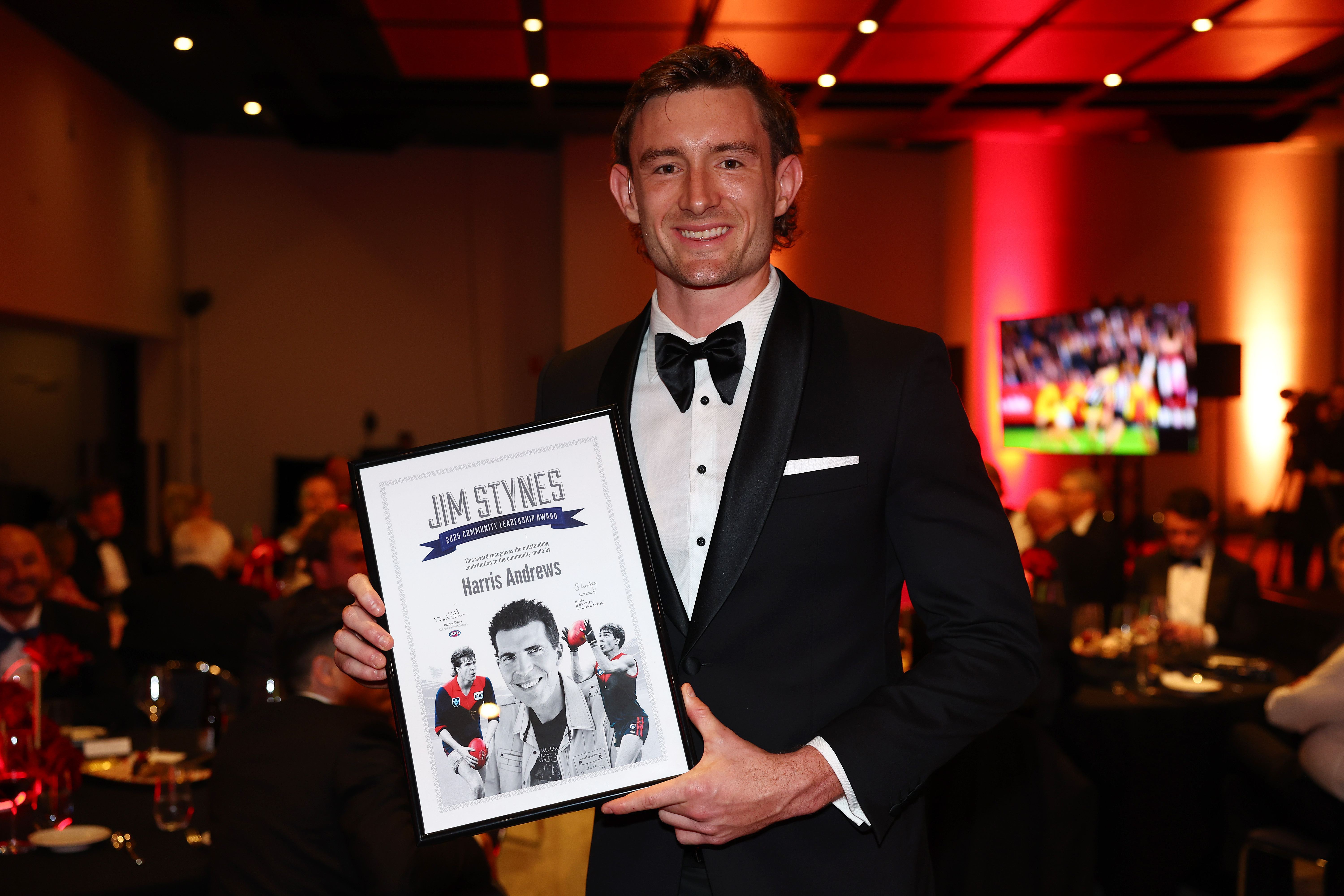
Ahead of Round 6, this weekend’s clash between the Melbourne Demons and the Brisbane Lions marks both Jim’s Game, in support of the Jim Stynes Foundation, and the launch of Harris Andrews’ Beyond DV Bursary, funded through his 2025 Jim Stynes Community Leadership Award.
On the eve of this occasion, Sam Ludbey-Stynes, founder of the Jim Stynes Foundation, had the opportunity to engage in a meaningful conversation with Andrews. The discussion explored his work with young people in the domestic violence space — and why leadership in today’s AFL is as much about impact off the field as performance on it.
What’s striking to me about Harris Andrews is that he is a juxtaposition to the narrative. His commitment to Beyond DV charitable work in the domestic violence space is not born from personal tragedy or lived experience, but from a deep sense of empathy, responsibility, and an understanding of the influence he holds as an AFL player. As Harris shared with me, “I don’t want to get to the end of my footy career without making a difference,” a reflection that captures both his intent and the clarity with which he approaches this work.
So often, the organisations that shape our communities are born from heartbreak. The Jim Stynes Foundation, established to continue my late husband’s legacy of empowering young people following his death from cancer. The Alannah and Madeline Foundation, created by Walter Mikac after the devastating loss of his daughters in the Port Arthur massacre. The Luke Batty Foundation, driven by Rosie Batty’s unimaginable grief following the loss of her son, and her determination to create systemic change in the face of family violence. These are stories of profound loss transformed into purpose.
Harris Andrews sits alongside these legacies in a different, yet equally important way.
As the recipient of the 2025 Jim Stynes Community Leadership Award for his charitable work with Beyond DV, supporting and educating young men to make positive and healthy changes within their relationships, Harris represents the next evolution of that legacy — one not shaped by lived trauma, but by conscious choice. He’s smart, currently studying teaching alongside being a dual Premiership player and he cares.
In fact, Harris speaks warmly of his upbringing, sharing, “I grew up in a loving family with mum and dad as great role models. My dad showed me what it means to be a respectful man, and the importance of showing respect towards women.” His advocacy demonstrates that you do not need to have endured trauma to stand up against it. You simply need the willingness to use your voice, your platform, and your influence to make a difference.
During our conversation, it quickly becomes clear within his resolute intonation that Harris does not see his role as optional. He recognises that leadership extends far beyond the boundary line — that it is about showing up, speaking out, and creating change before harm occurs.
In this way, Harris not only honours the legacy of Jim Stynes and his belief in young people as agents for change, but actively reinforces it. He carries forward the same conviction that influence is a privilege — and with it comes responsibility. It’s a mindset further shaped by the platform he holds.
“I’ve been in the AFL system for 12 seasons now, but I’ve been around local footy clubs since I was five… I do not want to be arrogant or cocky about it, but plenty of people look up to AFL players, on and off the field, and I feel a responsibility to lead young men in a constructive way. My motivation comes from being able to help even just one young man at a time — because that impact can change attitudes and behaviours - and extend far beyond what we see.”
A sponge for positive role models, Harris attributes his education and awareness in the domestic violence space not only to his family and local footy club upbringing, but also to two special and influential women in his life — his mentor Carolyn Robertson, Founder of Beyond DV and the Ask a Mate App, and his long-standing partner from teen years to adulthood, Em Halverson. “Em has been a great support to me… She’s opened my eyes to some of the challenges women face in society… and in a lot of ways I feel like I’m following in her footsteps as well.”
Harris’s connection to this work began in an organic and deeply personal way through his beginning with the Brisbane Lions community. “When I first meet Carolyn, she was a host family for newly drafted players. That’s how I got to know her. Years later she founded Beyond DV after her daughter and their family experienced domestic violence… That was probably my first real step into this space and where this work began for me.”
Carolyn speaks warmly of Harris: “Harris possesses an inner goodness. He helps bring hope… Harris embodies showing up for the younger men in your life.”
Harris’s story demonstrates the power of a football club as more than just a place of competition — but as a community capable of engaging in and driving meaningful change.
I witnessed this firsthand in 2025 when invited to attend a Collingwood Football Club team meeting to mark Jack Crisp surpassing Jim Stynes’ remarkable 244-consecutive game streak. Seeing his wife Mikayla and their three daughters present in that moment was powerful. It stood in stark contrast to a time when partners waited outside change rooms, often with children in tow. The evolution was clear — a culture of inclusion, respect, and recognition of family.
This shift is being driven by strong leadership and individuals willing to set a new standard across the AFL landscape. Harris believes there is more to be done. “As a community, we can keep building on that rather than focusing on negative stories… clubs, individuals and media all have a role to play in creating awareness and making the community environment better.”
He also highlights the importance of balance — not just for wellbeing, but for performance.
“When I’ve had balance — study, community work, life outside footy — it creates more energy to bring back into the game.”
And he acknowledges leaders like Darcy Moore, who are helping drive cultural change.
“He’s someone a lot of players look up to. He speaks articulately and is our President of the Players Association.” Each year on Brownlow night, Harris speaks about how much he values the opportunity to learn about players from other clubs being recognised for their work in the community. “I love tuning into the leadership award segment, where players giving back are celebrated and their stories are shared.”
Of course, change is not without resistance. But Harris remains grounded in a simple belief — that education and awareness is the key.
“If one young guy learns something, he might tell his mates and that can translate into five young people at school or the local footy club… and that’s how change spreads.”
He recognises that calling out sexist remarks, unconscious bias, misogynist or disrespectful behaviour must be done thoughtfully.
“It’s about education and forms of meaningful communication that are positive and stamp out embarrassment or shame.”
And that real progress comes from equipping young men with the confidence and communication skills to speak up — even when it’s not cool and uncomfortable.
Ultimately, Harris returns to the idea of responsibility — not as a burden, but as an opportunity.
“If you have a platform, if not me, then who?”
It is a mindset that echoes the spirit of Neale Daniher’s powerful “Why not me?” mantra — a philosophy born from his fight against MND yet grounded in the same belief: that even in the face of challenge or adversity, there is an opportunity to create purpose, to lead, and to make a difference.
While progress is evident, Harris acknowledges that shifting long-held attitudes is not without its challenges — particularly when navigating differing generational perspectives.
“I think we just have to keep moving forward as a generation,” he said. “Some of the older generation may not be as receptive to the changes we’re seeing — particularly when it comes to shifting outdated perceptions, including women playing football — but younger people are generally more open to it.”
“Generations will come, and generations will go.” he laughed.
When I asked Harris what childhood memory comes to mind that helped shaped his outlook, he reflected on a powerful early influence.
“Taylor Harris and I were in the same junior footy club… she was one of the best players out there. You’d hear comments like, ‘You kick like a girl.’ — but I’d think of her. She was kicking better than everyone. I just saw her as a great footballer. The construction of gendered identity never came into it.”
Through his work, Harris continues to shine a light on the power of positive role models — and the importance of supporting young men to speak up, seek guidance, and learn without fear of judgement.
Perhaps the question is no longer whether AFL players should be role models — that expectation now exists. The real question is how they choose to embrace it.
In Harris Andrews’ case, the answer is clear — and it is a powerful one.
Perhaps he is not a superhero in the traditional sense. But something far more profound — a role model superhuman who chooses, every day, to use his athletic talent, inner goodness and influence for good, and in doing so, helps shape a better future for the next generation.
The Demons will take on Harris’ Lions at the MCG this Sunday as the club hosts Jim’s Game – an acknowledgement of Club Legend Jim Stynes as well as a broader celebration of Irish culture – raising funds for the Jim Stynes Foundation.
Fans can support the Jim Stynes Foundation by clicking here. Anyone who donates $11 or more between now and Monday will go in the draw to win Max Gawn’s match-worn Jim’s Game guernsey.
